To me it was a great shock to see the remaining of the Al Askary shrine (or as we pronounce it in Farsi Asgary shrine). The shrine of Imam Hadi was the great attraction for Shias. My grand parents from both sides of the family visited the city (Samarra) and this shrine. They traveled to different cities in Iraq (Najaf, Samarra and Karbala) and they particularly went to Samarra to visit and worship the shrines of Ali al-Hadi and al-Hasan al-Askari, the 10th and 11th Shia Imams, and the site where the 12th Imam, Mohammed al-Mahdi, disappeared near a well. I don’t think the shrines had great architectural importance but it has spiritual importance for many Shia Muslims.
I still remember the souvenir my grandmother brought me from Samara: a pair of shiny beaded sandals.
Here I gathered a brief architectural history of Samarra :
one of the most prominent remains of this past is the famous Great Friday Mosque from 852 with the unique spiral minaret being the largest mosque of its time.
This mosque itself is predominantly in ruins, with only the outer walls standing. An ambitious restoration process began in the late 1990's, aiming at rebuilding the columns and eventually the roof. The spiral minaret is a separate structure from the main congregation hall, 27 meters north of the main hall. It is 52 meters high, and 33 meters in diameter. It is easily entered by a staircase spiraling up on the outside of the round walls. It is believed by many that the minaret was built about 15 years before the main structure.
In south of Samarra one can find a duplicate of the Great Friday Mosque, the Abu Duluf Mosque. The main hall is almost as big, 215 times 138 meters, but the minaret, once again spiral is only 19 meters high. When in 892 the Caliph moved back to Baghdad, Samarra lost most of its importance.
 The Great Mosque, Samarra,Iraq.
Samarra holds the tomb of two imams, the 10th, Ali al-Hadi and the 11th, Hassan al-Askari. They are placed in the same sanctuary, a structure that closely resembles the ones of Karbala and Najaf. In addition to the two imams, there are two other tombs of prominent female Muslims.
The second shrine of Samarra is meant to indicate where the 12th imam went into concealment. The shrine is quite different from the other Shia shrines of Iraq, as it doesn't have a golden dome (in 1905 the golden dome of the sanctuary of the 10th and 11th imams completed) but one covered with blue tiles. Underneath the dome there is a cellar, said to be the last place the 12th imam dwelled.
In February 22 of 2006 the shrine and mosque of the two imams, Ali al-Hadi and Hassan al-Askari, were destroyed in a bomb explosion.
 The Ruins of the dome of Imam Al Askary Shrine, Samarra, Iraq.
* Take a look at these interesting posts by Millinerd (Feb. 22 & 23) and My Other Fellow (Feb. 23)
I still remember the souvenir my grandmother brought me from Samara: a pair of shiny beaded sandals.
Here I gathered a brief architectural history of Samarra :
Samarra lies on the east bank of the Tigris River. In 836: Caliph al-Mu'tasim buys the land of a Christian monastery, and builds a military camp in it. He gives it the name "surra man ra'a" (he who sees it, rejoices), a pun based upon the nearby town of Samarra.
It is turned into the new residence of the Caliph, after he is pressured to move from Baghdad. This made it the capital of the entire Muslim world for 56 years which by now extended from Spain in the west to India in the east.one of the most prominent remains of this past is the famous Great Friday Mosque from 852 with the unique spiral minaret being the largest mosque of its time.
This mosque itself is predominantly in ruins, with only the outer walls standing. An ambitious restoration process began in the late 1990's, aiming at rebuilding the columns and eventually the roof. The spiral minaret is a separate structure from the main congregation hall, 27 meters north of the main hall. It is 52 meters high, and 33 meters in diameter. It is easily entered by a staircase spiraling up on the outside of the round walls. It is believed by many that the minaret was built about 15 years before the main structure.
In south of Samarra one can find a duplicate of the Great Friday Mosque, the Abu Duluf Mosque. The main hall is almost as big, 215 times 138 meters, but the minaret, once again spiral is only 19 meters high. When in 892 the Caliph moved back to Baghdad, Samarra lost most of its importance.
 The Great Mosque, Samarra,Iraq.
The second shrine of Samarra is meant to indicate where the 12th imam went into concealment. The shrine is quite different from the other Shia shrines of Iraq, as it doesn't have a golden dome (in 1905 the golden dome of the sanctuary of the 10th and 11th imams completed) but one covered with blue tiles. Underneath the dome there is a cellar, said to be the last place the 12th imam dwelled.
In February 22 of 2006 the shrine and mosque of the two imams, Ali al-Hadi and Hassan al-Askari, were destroyed in a bomb explosion.
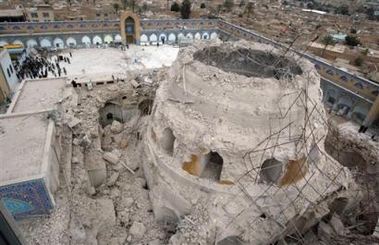 The Ruins of the dome of Imam Al Askary Shrine, Samarra, Iraq.
* Take a look at these interesting posts by Millinerd (Feb. 22 & 23) and My Other Fellow (Feb. 23)